
Port St. Lucie Directory Holdings
The verified historical run predates Port St. Lucie's incorporation. The National Archives directory inventory lists Fort Pierce directories that include St. Lucie County in selected years from 1916 through 1931. Those volumes are the correct first stop for pre-city residents, rural routes, and families tied to the county. No authoritative local catalog page found during research listed exact post-1961 Port St. Lucie Polk or criss-cross shelf years, so those editions must be confirmed with library staff rather than assumed.
| Collection | Years | Where Held | Access |
|---|---|---|---|
| Fort Pierce directories including St. Lucie County | 1916, 1918, 1920-23, 1927-28, 1931 | NARA inventory; scans may be found through library databases | NARA or library |
| Federal population census | 1790-1950 public | NARA, HeritageQuest, Ancestry Library Edition | Free NARA access or library license |
| HeritageQuest family and local histories | 25,000+ histories and books | St. Lucie County Library | Branch or remote with library card |
| Regional artifacts and local history | County history themes | Regional History Center, Fort Pierce | Tuesday-Saturday; admission charged |
The listed directory years are discontinuous. Absence from 1917 or 1924 cannot show that a household left St. Lucie County because no annual run was verified for every intervening year. Call the Kilmer reference desk at 772-462-1615 to check later city directory or telephone-book holdings before traveling.
The captured NARA city-directory inventory provides the authoritative early year list. 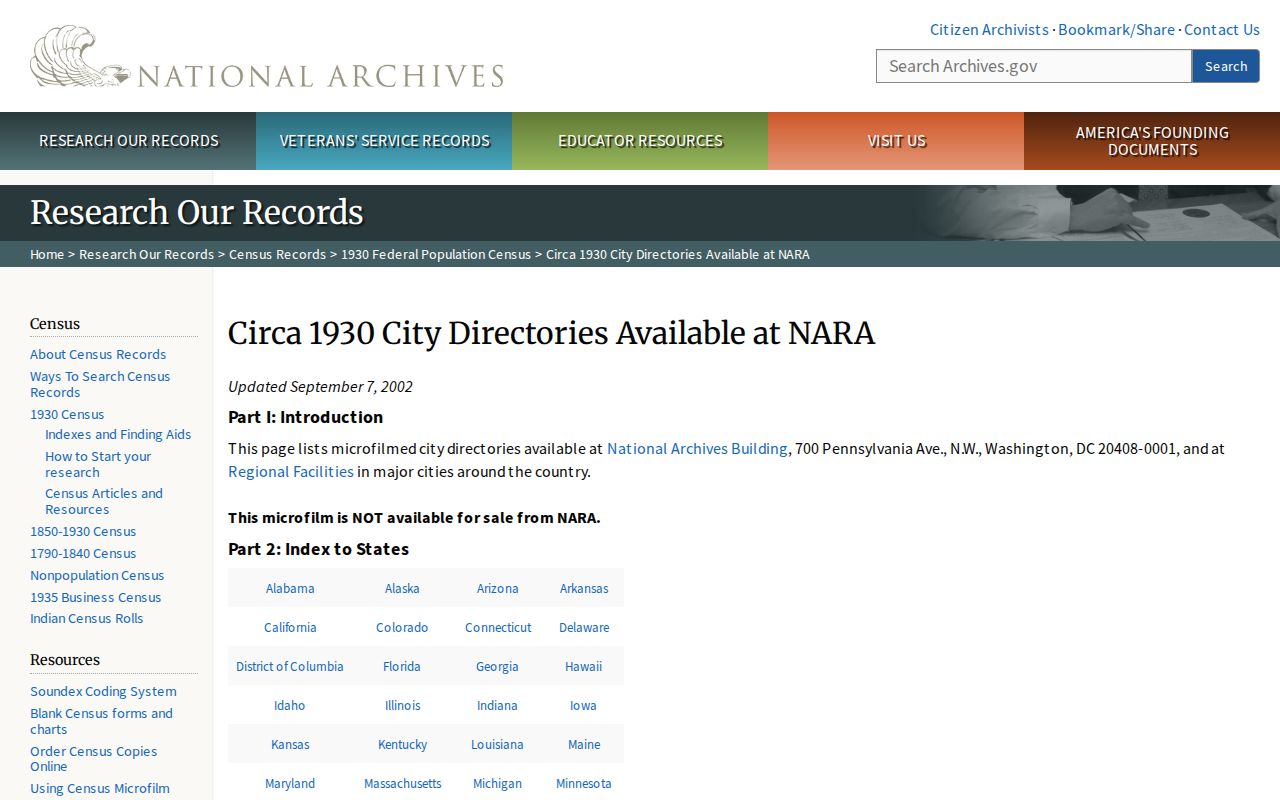 Its Fort Pierce and St. Lucie County headings explain why a modern city-name search alone misses early families.
Port St. Lucie Directory Geography
St. Lucie County's modern formation dates to 1905, but Port St. Lucie was not incorporated until 1961. A city directory from the 1910s, 1920s, or 1930s therefore will not describe Port St. Lucie as the mature city known today. Search the Fort Pierce alphabetical pages, county sections, and rural-route entries. Copy the printed place and street wording exactly.
This chronology is more than a naming detail. The open 1950 federal census also predates Port St. Lucie cityhood. Researchers looking for an early resident must work through predecessor geography, county land records, and Fort Pierce directory headings. Modern neighborhood names may not appear at all.
Port St. Lucie Directory Years
The verified NARA sequence is 1916, 1918, 1920, 1921, 1922, 1923, 1927, 1928, and 1931. This short timeline helps pair a city directory with a census without pretending that an edition exists for each year.
| Year | Best companion record |
|---|---|
| 1916 and 1918 | County deeds, military-era records, newspapers, and the 1910 or 1920 census |
| 1920-1923 | The 1920 census, parcel history, probate, and adjacent directory editions |
| 1927-1928 | Newspapers, deeds, and the approaching 1930 census |
| 1931 | The 1930 census and later county records |
| After 1950 | Deeds, newspapers, school yearbooks, permits, and verified later directories |
A city directory disappearance has several possible causes. The person may have moved, died, become unlisted, or been omitted from that edition. Confirm the change through deeds, probate, an obituary, or the next available directory year.
Read Port St. Lucie Directory Entries
Begin with the edition's own key. Historical abbreviations were chosen by the publisher and may change between volumes. An alphabetical entry usually gives a surname and given name or initial. A spouse may appear in parentheses. The line may add an occupation, employer, residence, business address, or widow notation. Never expand a mark from memory when the printed key is available.
| Name | Surname plus given name or initials; a spouse may appear in parentheses |
|---|---|
| Occupation | Trade and sometimes an employer, which can separate same-name people |
| Address | House number and street, sometimes with residence or boarding marks |
| Business address | A work site that must not be mistaken for the home address |
| Widow notation | A relationship clue that should be checked in death, obituary, or probate records |
- Criss-cross directory
- A reverse section arranged by street and house number, often with an occupant or telephone entry.
- Householder index
- A list focused on the person identified as head of a household, not every resident at an address.
- Abbreviation key
- The edition-specific legend that defines marks such as r, h, bds, and shortened trade names.
Photograph or copy the title page and abbreviation key with the entry. Also record the page number and heading. That small habit makes a later citation clear and keeps a county entry from being mislabeled as a Port St. Lucie city entry.
Port St. Lucie Directory Access
The St. Lucie County Library genealogy service supplies two distinct routes. HeritageQuest works in a branch or remotely with a library card and includes census material plus more than 25,000 family and local history books. Ancestry Library Edition must be used inside an open branch or through branch Wi-Fi. It adds military, court, land, probate, and immigration collections.
Library access is decentralized while the namesake Port St. Lucie Branch is rebuilt. That branch closed August 30, 2025, with an expected reopening in 2027 after expansion. Lewis, Morningside, Pruitt, and Kilmer provide alternatives. Treasure Coast Genealogical Society volunteers have offered free walk-in help at Lewis Branch, 2950 SW Rosser Boulevard. Confirm current dates at 772-871-5470.
HeritageQuest is the best unattended census fallback. Ancestry requires a trip, but a branch visit can also resolve a catalog question or connect a city directory find to another licensed collection.
Pruitt Campus Library in St. Lucie West is a joint-use county branch and gives west-side researchers a local database point. Morningside offers the Digital Studio. A catalog item may still be housed at Kilmer, so call ahead before planning a visit around a print volume.
Branch access also changes how evidence is saved. Download a census image with its collection title, year, enumeration place, sheet, and household line. For a directory page, preserve the volume title, publication year, city or county heading, page number, and abbreviation key. These details distinguish a Fort Pierce county entry from a later Port St. Lucie address and let another researcher retrace the result.
Port St. Lucie Directory Shelves
The State Library of Florida city-directory collection is arranged by city and year. Its catalog and staff can identify a volume even when no scan is online. Do not confuse a catalog record with digital page access. A useful request gives the place heading, target year, surname, and any known street or business.
The successful manifest image shows the State Library's city-directory resource. 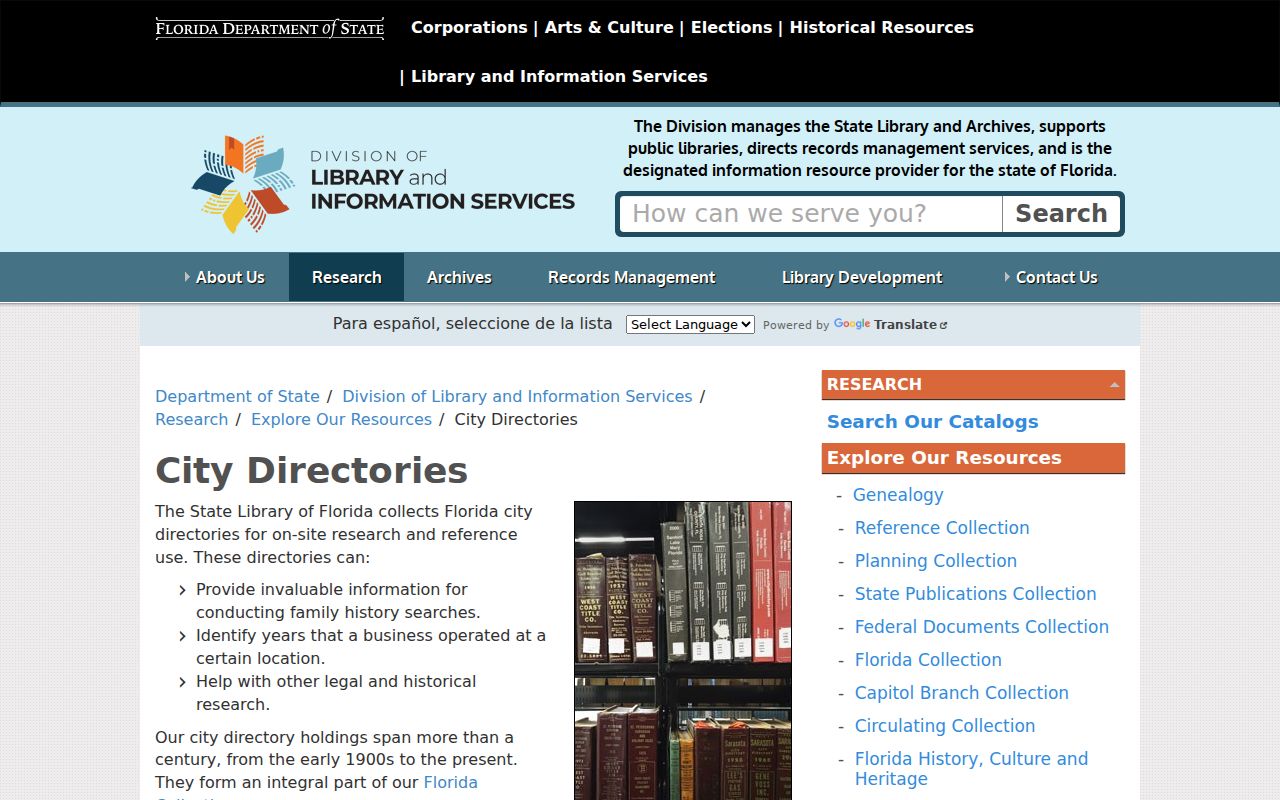 It provides a second collection path when local holdings are uncertain, while the verified NARA list remains the source for the early St. Lucie year sequence.
Port St. Lucie Directory Context
The St. Lucie County Regional History Center at 414 Seaway Drive in Fort Pierce interprets Indigenous life, fishing, pineapple promotion, retail and printing, domestic history, and the Gardner House. It is open Tuesday through Saturday from 10 a.m. to 4 p.m., and admission is charged.
Call 772-462-1795 before assuming an exhibit label means an open manuscript collection. Even when the center does not hold the exact directory, its themes point to business advertisements, newspapers, land files, and household artifacts that can explain a terse name-and-address entry.
Fishing, pineapple, printing, and retail themes can also explain an occupation or business line printed beside a resident's name. Compare the directory wording with a dated newspaper advertisement or land record, then use probate and vital records for relationships. Local context helps interpret an entry, but it should not replace the underlying citation.
Note: Morningside Branch's Digital Studio can preserve family films, photographs, and VHS material that has never appeared in a government index.
Reverse Port St. Lucie Directories
A criss-cross section reverses the normal city directory order. Instead of starting with a surname, search the street, then scan house numbers. The entry may show an occupant or telephone listing. This can place neighbors near a known address and reveal a change between editions.
Exact local post-1961 reverse-directory years were not verified in an official catalog during research. Ask library staff which editions and formats are actually held. For a modern parcel or a full street, use the Port St. Lucie street directory workflow instead of forcing an old shelf tool to answer a current ownership question.
Trace Port St. Lucie City Directories
City directories fill the years between federal census releases. Begin with one supported name, year, or address. Search both the alphabetical section and any street section, then move to the closest earlier and later editions. Keep the printed place heading because a Fort Pierce or county label is expected before Port St. Lucie incorporation.
- Find the first supported appearance and copy the entire line, page, title, year, and heading.
- Compare the nearest available editions, noting address, spouse, occupation, and name variants.
- Check the reverse section, when one exists, for the address and nearby households.
- Pair the 1920 directory years with the 1920 census and the 1931 edition with the 1930 census.
- Use deeds and probate to distinguish owners from boarders and to separate people who share a name.
- Close a disappearance with an obituary, cemetery record, probate file, later directory, or deed.
After 1950, the census closure leaves a wider gap. Directories, deeds, newspapers, school yearbooks, and Port St. Lucie permits can bridge it. An obituary may connect relatives, but check names and relationships against probate or an official vital record. Each source should confirm a specific part of the family trail rather than stand as proof of everything in the household.